Black mana
The Calamitous BobBlack mana is a magical force associated with death, change, shadows, and destruction. Its decisive significance lies in the way it operates simultaneously as environmental catastrophe, personal hazard, and source of power: Harrak is saturated with it to the exclusion of every other mana, while Viviane Saint-Lys gradually learns to use the same force that threatens to kill her. The book therefore treats Black mana less as a moral category than as a dangerous material and conceptual alignment whose effects depend on concentration, affinity, and control.
Definition and Moral Alignment
Black mana is explicitly connected with death, change, shadows, and destruction, but it is not inherently evil. That distinction prevents the color from functioning as a simple supernatural equivalent of wickedness. Its associations describe tendencies and effects rather than a fixed ethical identity. The force can support magical development, preserve an advantage in a hostile environment, or amplify a spell, even while its concentration poisons living bodies and sustains undead creatures.
The concept becomes more severe as Viviane Saint-Lys gains experience with it. Solfis explains that mana can be charged with concepts and that each color makes spells more specialized. Viviane eventually understands Black mana not merely through an abstract description but through its alignment with her own resentment and the destructive energy moving through her body. In her interpretation, death and change are partial truths: Black mana represents a deeper movement toward annihilation, an order defined by heat death. This is a conceptual conclusion reached through bodily experience, not a detached scholarly definition.
Harrak and the Deadlands
The western region of Param bears the physical stigma of the greatest magical catastrophe ever recorded. The former seat of the Old Empire has become a vast valley enclosed by snow-capped mountains, with a dark center gradually giving way to greener margins. The ruined imperial city is filled with dead estates, temples, churches, squares, basaltic sand, and rubble on the scale of apartment buildings. At the top of an enormous pyramid, a crater with vitrified, molten edges suggests an impact comparable to an asteroid strike or tactical nuclear warhead. The landscape makes the destructive history of Black mana visible as architecture, geography, and absence.
The region’s saturation has practical consequences for survival. Solfis warns that the concentration of Black mana in the city of Harrak will kill Viviane Saint-Lys within four days and render her unconscious within three and a half. The threat is not limited to monsters. The settlements and camps she observes have avoided the abundant buildings around them, implying that the region receives no rain; the surrounding land is also devoid of dried grass or any renewable food source. Black mana has therefore made Harrak not merely dangerous but ecologically closed, a place where shelter exists without nourishment and where the absence of ordinary life becomes evidence of the magical environment.
As Viviane Saint-Lys approaches the southern gap in the mountains, the saturation begins to fade. The plains remain marked by dark shrubbery and zombies, but beyond the gap a dense, unmistakably living forest appears. This transition gives Black mana a visible boundary: the gray and necrotic interior of the Deadlands contrasts with green land capable of supporting ordinary life. The change is gradual rather than instantaneous, allowing mana density to function as an ecological gradient between catastrophe and recovery.
Ecological Persistence and Historical Legacy
Black mana does not simply dissipate when the event that created it has ended. Cernit explains that the Deadlands have reached an equilibrium in which the numerous undead monsters generate a Black field of their own. A large-scale expedition might kill enough creatures to dent that field, but no kingdom is willing to spend the necessary resources on land considered worthless when easier regions are available for development. The region consequently perpetuates itself through a feedback loop: Black mana supports undead life, the undead sustain the field, and the field prevents ordinary life and settlement from returning.
This persistence also gives the Old Empire’s collapse a material afterlife. The empire died at the height of its power, but its magical achievement remains active as a hostile environment. Its legacy survives in scattered private collections and in the languages of kings, while its former center is occupied by mindless undead. Black mana thus links imperial grandeur to imperial ruin: the same civilization that reached unprecedented magical heights created a landscape whose destructive residue outlasted its institutions.
The wider world understands Harrak as a political and geographic boundary as well as a magical one. The Baranese knights describe the western end of Param as separated from Baran by several countries, while the map marks the Harrakan heartlands with a skull. Later, Kazar belongs to Enoria, a kingdom that fractured fifteen years earlier after a failed coup and a bloody civil war. Against this network of states, Black mana marks the abandoned zone that kingdoms monitor but do not reclaim. It is a force that reorganizes borders by making one region too costly to possess.
Viviane Saint-Lys’s Affinity and Risk
Black mana is central to Viviane Saint-Lys’s survival because she possesses extreme compatibility with mana even while her mana channels are only budding. Her affinity makes the force unusually useful to her, but usefulness does not remove its cost. After surviving the effects of Harrak’s saturation, she spends days recovering from mana poisoning and remains vulnerable to further harm. Her lack of alignment initially delays the poisoning, while achieving full Black alignment later reduces it; neither condition makes the danger disappear. The relationship is therefore one of adaptation under pressure rather than effortless mastery.
During training, her manipulation remains at the lowest possible stage, and progress becomes exponentially harder as she learns more. The physical symptoms—constant headache and fever—also undermine the pleasure of practice. At first, her achievement is modest: she can emit black smoke from a fingertip, a trick that leaves its victim feeling sick. Yet her improvement becomes concrete. Her charged Bzzt! spell grows as thick as two fingers, and her Black cloak extends to mid-thigh. Solfis varies exercises by asking her to curve or straighten the bolt and to smooth the cloak, turning Black mana from a frightening environmental fact into a technical discipline with repeatable forms.
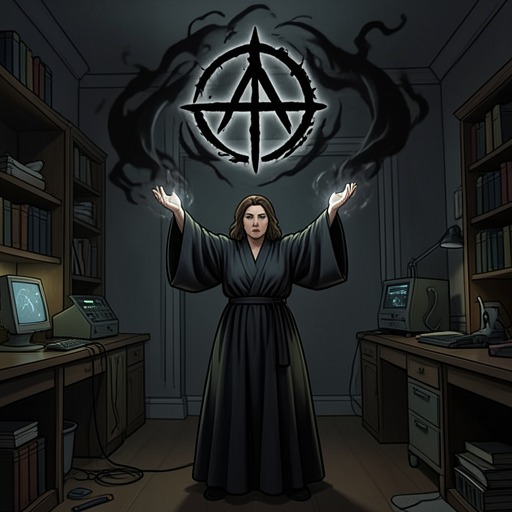
The decisive transformation occurs when Viviane Saint-Lys chooses the Black Witch path. Under that path, her mental statistics become three times more efficient when wielding Black mana, though only fifty percent more efficient with other types, and she can no longer manipulate life mana. Associated skill acquisition is vastly improved. The path therefore offers specialization in exchange for exclusion: Black mana becomes a major source of efficiency and growth, but it closes off an entire magical domain. The choice makes her dependence on the force systemic rather than temporary.
When the mana returns, it causes pain and produces Black flames from her skin as her conduits become saturated. She ignores the warning of mild mana poisoning and experiences the force directly, discovering that its tempestuous power responds particularly strongly to her deep resentment. This moment clarifies the reciprocal danger of alignment. Black mana does not merely pass through a neutral vessel; it becomes more potent and legible when joined to an emotional state already compatible with its destructive concepts.
Narrative Function and Significance
Black mana gives the setting a continuous scale connecting ruined history, hostile ecology, magical mechanics, and character psychology. In Harrak, it is the residue of civilization’s greatest catastrophe; in the Deadlands, it is a self-reinforcing field maintained by undead populations; in Viviane Saint-Lys, it is poison, training material, emotional resonance, and chosen identity. The movement from the dead city toward the living forest makes that scale spatially perceptible, while the contrast between the Cassian Spring and the Deadlands suggests that magical forces can also produce blessing and renewal rather than only contamination.
Its most important tension is the gap between moral neutrality and destructive tendency. Black mana is not inherently evil, yet its deepest conceptual direction is annihilation, and its environmental consequences include infertility, unconsciousness, poisoning, zombies, revenants, and the long-term exclusion of kingdoms. The book preserves both truths without resolving them into a simple alignment of good and bad. Black mana can be learned and used, but it cannot be made harmless; it can be resisted, but its effects remain embedded in the world. That combination makes it one of the book’s principal mechanisms for turning abstract magic into history, ecology, bodily experience, and irreversible choice.